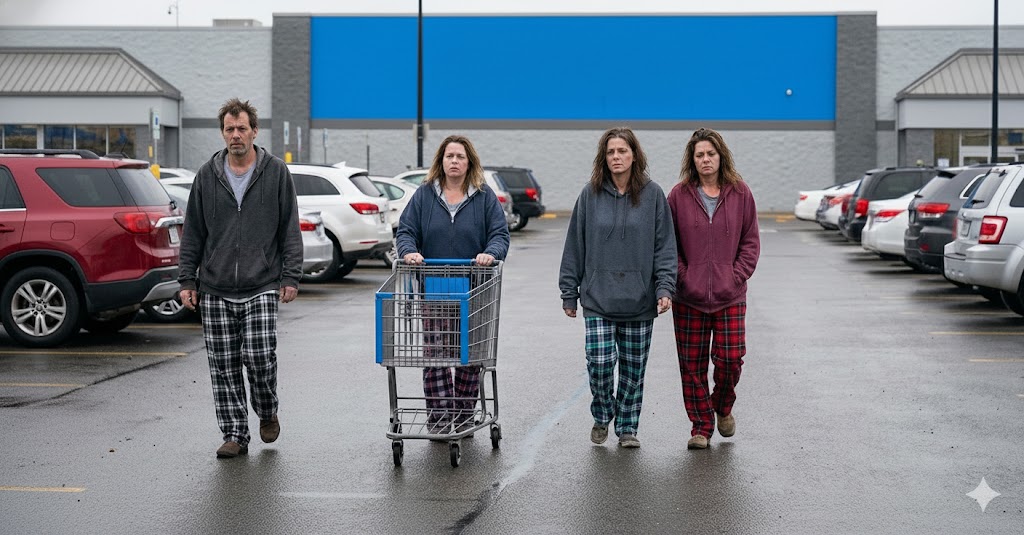
MONROE COUNTY, MI — Residents of Monroe County may soon need to rethink their grocery-store attire after county officials confirmed they are exploring a total ban on pajama pants in public spaces countywide. The move, which has been dubbed by critics as the “Flannel and Fleece Decency Act,” is a sweeping effort to restore what officials call “basic community standards.”
The proposal, discussed during a recent county committee meeting, would prohibit pajama pants from being worn in public places anywhere in the county, including stores, restaurants, government buildings, and public events. If approved, it would apply to all communities in Monroe County, from cities to townships, leaving no jurisdiction safe for Snoopy flannel.
YOU MIGHT LIKE

More News
The “Downriver Drape” Crisis
The idea gained momentum after repeated complaints from local business owners who say pajama pants have become the unofficial uniform of the “I gave up, but I still went out” lifestyle.
“We started noticing it during the pandemic,” said one county commissioner, who requested anonymity for fear of being targeted by a pillow-fight protest. “It was understandable when everyone was trapped at home, but then it just… never stopped. We’ve reached a point where people are attending city council meetings in fleece bottoms featuring the cast of Frozen. It’s a crisis of dignity.”
Officials are specifically targeting what they call the “Downriver Drape”—the act of wearing thin, patterned cotton bottoms tucked into winter boots or paired with slippers at a Meijer checkout lane.
Scientific Analysis: The “Comfort-to-Apathy” Pipeline
To support the ordinance, the county reportedly reviewed a (fictional) white paper from the Great Lakes Institute of Societal Standards. The study suggests that there is a direct correlation between the softness of a person’s pants and their willingness to follow traffic laws.
“Our data shows that once a citizen realizes they can purchase a gallon of milk in the same clothes they slept in, the social contract begins to unravel,” the study claims. “Pajama pants represent a psychological surrender to the couch. When you wear plaid fleece in public, you aren’t just comfortable; you’re a flight risk for social order.”
The study further categorized pajama pants as “high-risk textiles,” noting that flannel can hold up to three times its weight in grocery store floor bacteria, making it a public health concern—or at least a very gross aesthetic one.
The Proposed “Bedtime Enforcement” Scale
The proposed ban would define pajama pants using a specific “Bedtime Scale.” According to the draft ordinance:
Prohibited: Any loose-fitting bottoms marketed as sleepwear, including flannel, fleece, and novelty prints featuring cartoon characters or holiday themes.
Prohibited: Any pants with a drawstring that is clearly a shoelace-style ribbon.
Permitted: Joggers, sweatpants, and yoga pants—provided they are made of a material thick enough to be considered “structural” rather than “drapery.”
“Joggers have zippers and pockets,” explained one attorney assisting the county. “Pajamas have a false sense of security. That is the legal distinction we are drawing in the sand—or in this case, the lint.”
The “Jogger vs. Pajama” Identification Guide
For those worried about accidental fines, the county is reportedly releasing a “visual aid” for local retailers. According to the draft, a garment is officially a pajama if it meets more than three of the following “Slump Criteria”:
The Lint Factor: If the fabric naturally attracts more than 40% of its own weight in cat hair within ten minutes, it is a pajama.
The Structural Integrity Test: If the waistband relies entirely on a piece of string that looks like it was harvested from a hoodie, it is a pajama.
The Pattern Rule: Any print involving snack foods, sleeping animals, or “ironic” holiday themes is a non-negotiable violation of the public decency act.
The Knee-Sag Index: If the knees of the pants remain in a “sitting position” even while you are standing up, you are wearing pajamas.
Historical Precedent: The 1924 Monroe Nightgown Riot
Local historians note that this isn’t the first time the county has tried to regulate bedtime attire. In the summer of 1924, a local ordinance attempted to ban silk nightgowns from being worn on front porches. The resulting “Nightgown Riot” saw dozens of residents marching down Front Street in their finest lace, forcing the city council to retreat into a nearby haberdashery.
“History repeats itself,” says local archivist Mary Putter. “One century it’s silk nightgowns, the next it’s polyester fleece featuring the cast of The Office. The battle for comfort is a long and itchy one.”
A Final Warning for the Weekend
As the Board of Commissioners prepares for their final vote next Tuesday, they have issued a “Good Faith” request to all citizens: please, just for one weekend, try wearing a pair of chinos. “Just see how it feels,” the memo reads. “The zipper won’t bite you, and you might find that having pockets that can actually hold a set of keys is a life-changing experience.”
Grassroots Resistance: The “Nap-In” Protests
Reaction from residents has been swift and dramatic. A local group calling itself S.O.F.T. (Society of Fleece Technologists) has already organized a “Nap-In” protest on the lawn of the County Building.
“This is government overreach into my dresser drawer,” said Gary ‘Comfy’ Miller, a local activist seen wearing plaid pajama pants and a bathrobe. “What’s next? A ban on bedhead? Mandatory pomade? If I want to buy my 2-for-$5 frozen pizzas while wearing pants with dancing tacos on them, that is my constitutional right as a Michigander.”
Enforcement and “Panty-Line” Inspections
If passed, enforcement would begin with “Educational Warnings.” Local law enforcement would be equipped with “Textile ID Cards” to help them distinguish between high-end loungewear and literal pajamas.
“We aren’t looking to throw people in jail,” said a local sheriff’s deputy. “But if we see you at the Monroe Meijer in pants that have a matching nightcap, we’re going to have a conversation. Repeat offenders could face fines starting at $25—the approximate cost of a pair of real jeans at a thrift store.”
A Community Divided
As the debate rages, local businesses are taking sides. Some shops have already posted signs reading: No Shirt, No Shoes, No Real Pants, No Service. Others, however, are leaning into the “Sleepy Economy,” offering discounts to anyone brave enough to defy the proposed ban.
For now, no final vote has been taken. But if Monroe County moves forward, it could become the first county in the nation to legally draw a firm line between the bedroom and the boardroom.
Until then, officials offer simple advice: “If your pants are the reason you’re falling asleep at red lights, it’s time to change.”