Cortina d’Ampezzo, Italy – The Winter Games have long been a showcase for human courage, aerodynamic helmets, and the willingness to slide down an icy chute at highway speeds while lying on your back. This year, however, organizers have unveiled a new event that has athletes, engineers, and chiropractors equally intrigued: the Mixed 3-Person Luge.
Officially introduced at the Winter Olympics, the event builds on the legacy of traditional singles and doubles luge, overseen by the International Luge Federation. The premise is straightforward: three athletes, one sled, zero room for error.
If singles luge is a test of individual nerve, and doubles luge is a study in trust, mixed 3-person luge is something closer to a group project where everyone actually has to show up and do their part — at 80 miles per hour.
YOU MIGHT LIKE


How It Works
The rules, according to Olympic officials, are “elegantly simple and mildly terrifying.”
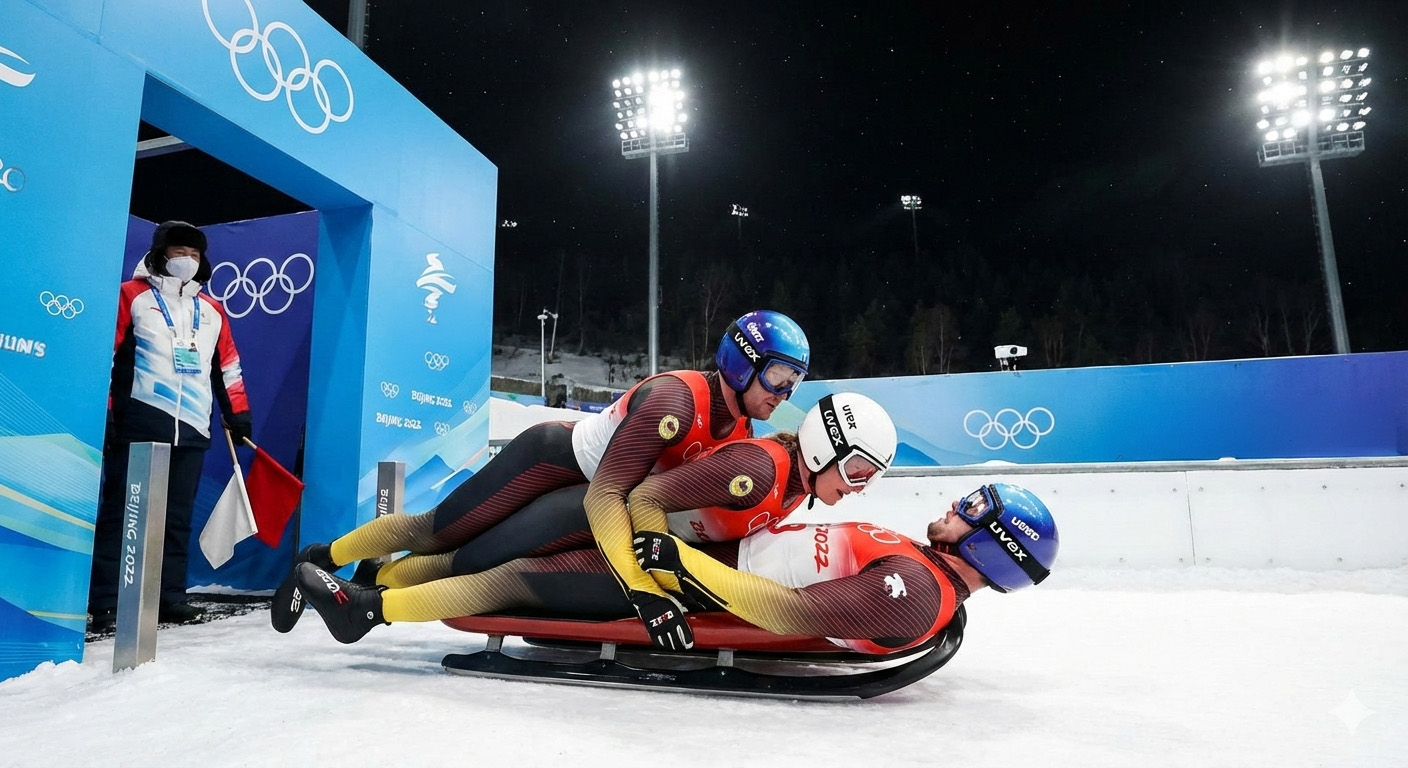
The bottom athlete lies flat on their back, hands gripping the sled’s handles. The second athlete lies stomach-down directly on top of the first. The third athlete completes the stack, also stomach-down, forming what commentators have diplomatically described as a “streamlined human totem of ambition.”
At the starting gate, all three athletes must coordinate a synchronized paddle-off — a frantic flurry of gloved hands against the ice — before tucking in and surrendering to gravity. Within seconds, they’re rocketing down the track, navigating banked curves and G-forces with the kind of teamwork typically reserved for synchronized swimming or assembling flat-pack furniture.
Unlike relay-style team events, this format keeps all three athletes on the sled for the entire run. There are no substitutions, no baton passes, and no convenient moments to reconsider life choices.
Engineering the Impossible
To accommodate the added athlete, sled manufacturers have worked overtime to design a longer, reinforced sled that remains within strict weight limits. Engineers insist the new model is safe, stable, and “only slightly resembles a high-speed sandwich.”
Aerodynamics were the primary challenge. A third body increases drag, which in luge can mean the difference between gold and politely clapping for someone else. Teams experimented with helmet shapes, suit materials, and even synchronized breathing patterns to reduce wind resistance.
“We found that exhaling at the same time shaved off milliseconds,” said one national team coach. “It’s not enough to win on its own, but in this sport, milliseconds are everything. Also, it keeps everyone from arguing mid-run.”
More News



Strategy on Ice
While the spectacle of three athletes stacked on a sled captures headlines, insiders say the event is deeply strategic.
The bottom athlete — often the most experienced — handles steering, using subtle pressure shifts in their calves and shoulders to guide the sled. The middle athlete must maintain perfect alignment, acting as both stabilizer and aerodynamic buffer. The top athlete, meanwhile, plays a crucial role in balance and weight distribution.
“It’s not just about strength,” explained a veteran competitor. “It’s about trust. You have to believe the person under you is steering correctly. And the person above you has to believe you’re not about to sneeze.”
Mixed 3-person luge is also the first luge discipline to mandate pre-run communication drills. Teams are required to demonstrate a system of non-verbal cues — slight taps or pressure shifts — to ensure coordination through tight curves. Verbal communication, for obvious reasons, is discouraged once speeds exceed conversational levels.
A Subtle Shift Toward Inclusion
Olympic officials describe the event as a celebration of collaboration and mixed-gender participation. Each team must include at least one athlete of a different gender than the others, reinforcing the Games’ broader push for inclusivity.
Fans have responded with curiosity and, in many cases, admiration. Early exhibition runs drew packed stands, with spectators collectively holding their breath as sleds whipped through the course’s most infamous turns.
Commentators have embraced the challenge of describing the action without resorting to chaos metaphors. Phrases like “beautifully layered technique” and “stacked synergy” have become staples of the broadcast lexicon.
Training for Togetherness
Preparing for mixed 3-person luge requires more than physical conditioning. Teams report spending hours practicing mounting and dismounting the sled with choreographed precision. A clean start can set the tone for the entire run; a clumsy one can add precious tenths of a second.
Off the track, athletes focus on core strength, flexibility, and what coaches refer to as “positional diplomacy.” In a sport where inches matter, comfort and cooperation are essential.
One athlete joked that the event has strengthened friendships. “After you’ve hurtled down an ice track in a three-person stack, you either bond for life or agree to compete in different sports next season.”
The Spectator Experience
From a viewer’s perspective, mixed 3-person luge offers the familiar thrill of traditional luge with an added layer of intrigue. The longer sled and higher combined weight create slightly different lines through curves, leading to subtle variations in speed and trajectory.
Broadcasters have leaned into slow-motion replays, highlighting the precise alignment of helmets and the synchronized tension in each athlete’s frame. Analysts dissect steering decisions with the seriousness usually reserved for chess grandmasters.
The event’s debut has also inspired a surge in youth interest. Luge clubs report an uptick in inquiries from aspiring sliders eager to try the new format — though most programs are starting with the traditional one- and two-person disciplines for obvious logistical reasons.
A Measured Success
As the competition unfolded at the Winter Olympics, medal ceremonies featured visibly relieved athletes who had successfully navigated the course without incident. Winning times were tight, with margins measured in hundredths of a second.
Officials from the International Olympic Committee praised the event’s smooth rollout. “Innovation is part of the Olympic spirit,” one spokesperson said. “We’re proud to introduce a discipline that highlights teamwork, precision, and the remarkable adaptability of our athletes.”
There is already talk of refining the format for future Games — perhaps adjusting sled specifications or tweaking start procedures. For now, mixed 3-person luge stands as a testament to the enduring creativity of winter sport.
Sliding Forward
The Winter Olympics have always balanced tradition with evolution. From new snowboarding tricks to ever-faster speed skating records, each Games finds fresh ways to test the limits of human performance.
Mixed 3-person luge may have raised a few eyebrows at first glance, but it has quickly proven itself as more than a novelty. It is a study in cooperation under pressure, a lesson in shared momentum, and a reminder that sometimes progress comes in layers.
As athletes pack up their sleds and fans replay their favorite runs, one thing is clear: the icy track has room for innovation — even if the sled itself does not.
And somewhere, high above a frozen chute carved into the mountainside, three athletes are looking at each other and thinking the same thing: next time, we can go even faster.