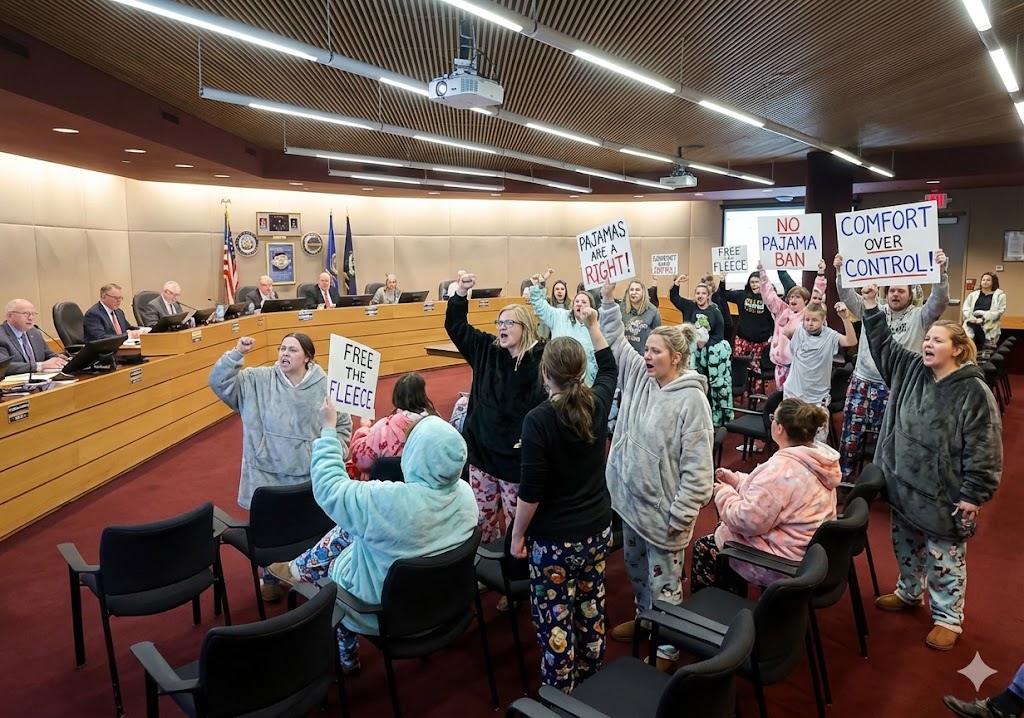
MONROE COUNTY, MI — What began as a quiet committee discussion regarding public dress codes has spiraled into what local historians are calling the “Great Flannel Uprising of 2026.” Monroe County officials were forced to adjourn a public hearing early Tuesday night after the meeting room was overtaken by a sea of residents wearing mismatched fleece, oversized bathrobes, and slippers.
The backlash follows a proposal to ban “sleepwear-style bottoms” in government buildings and public businesses, a move that the Board of Commissioners claims was meant to “elevate the dignity of the county.” Instead, they have ignited a grassroots movement that shows no signs of going to sleep.
YOU MIGHT LIKE


A Sea of “Lazy” Resistance
By 6:00 PM, the parking lot of the County Building resembled a giant, angry sleepover. Protesters, organized under the hashtag #PantsOffMonroe, arrived en masse. The air was thick with the scent of fabric softener and rebellion.
“We aren’t just here for comfort,” shouted Brenda ‘Static-Cling’ Higgins, a spokesperson for the newly formed Society of Fleece Technologists (S.O.F.T.), who was wearing a full-body onesie featuring the Detroit Lions logo. “We are here for our rights. If the government can tell us our pants are too soft, what’s next? Mandatory belts? Starch? This is a slippery slope, and we are sliding down it in our silk boxers.”
Higgins and her followers argue that the “Flannel and Fleece Decency Act” is a direct violation of their personal liberties. The group has even drafted a “Manifesto of Mugginess,” demanding that the county recognize pajamas as a protected form of cultural expression for the “overworked and under-caffeinated.”
The “Dr. Fleece” Testimony
Inside the hearing, the tension peaked during the testimony of Dr. Arnie Fleece, a self-described “Textile Psychologist” from the Carleton School of Comfort.
“The human spirit is not meant to be encased in denim,” Dr. Fleece told the board while gesturing to a chart showing the ‘Vibe-killing Properties’ of zippers. “When a citizen wears pajama pants to the post office, they are operating at a 40% lower stress level. By forcing them into slacks, you are effectively inducing a county-wide state of anxiety. You are essentially legislating high blood pressure.”
Dr. Fleece’s testimony was met with a thunderous round of applause, primarily executed by people hitting pillows together, which created a muffled, thumping sound that confused the court reporter.
The Jeans vs. Dreams Debate
The board attempted to defend the ordinance by presenting a “Wall of Shame” featuring photos of residents at the local DMV wearing pants so thin they were practically structural suggestions.
“We saw a man last week in a pair of flannel pants featuring the ‘Minions’ that had more holes than a block of Swiss cheese,” said one commissioner, who requested anonymity for fear of being targeted by a pillow-fight protest. “There has to be a line. We are a top-tier Michigan county, not a 3:00 AM basement at a frat house.”
However, the argument backfired when a local veteran stood up and produced a pair of stiff, starched jeans from 1985. “I fought for the right to never have to wear these again,” he declared. “If I want to go to the treasurer’s office in my ‘Taco Tuesday’ flannels, that is the freedom I was promised.”
The “Business-Pajama” Compromise
As the hearing devolved into shouting, the county legal team floated a “Middle Ground” policy. The proposed “Hybrid Textile Act” would allow pajama pants in public only if they met specific criteria:
No Cartoon Characters: Novelty prints would be restricted to “serious” patterns like plaid or solid navy.
The “Boot Requirement”: Pajamas would be legal if worn with “professional footwear” (no Crocs with socks).
The Faux-Fly: All public pajamas would be required to have a decorative, non-functional button-fly to give the illusion of effort.
The compromise was rejected almost instantly by both sides. Protesters called it “textile segregation,” while the board called it an “enforcement nightmare.”
Economic Fallout: The “Slippery” Slope
Local economists are also weighing in on the potential ban. A report from the Monroe Institute of Retail Fabric suggests that a ban on pajamas could result in a 15% drop in impulse grocery purchases.
“People buy more snacks when they are in pajamas,” said lead analyst Sarah Thread. “When you’re wearing real pants, you feel the waistband tightening. That’s a natural deterrent to buying a three-pound bag of gummy bears. If people have to dress up to go to Meijer, they’re going to be much more mindful of their caloric intake. The local snack economy could collapse overnight.”
The International Eye on Monroe
The controversy has reached far beyond the Michigan border. International news outlets have picked up the story, with some European tabloids mocking the county as “The Town That Hates Comfort.”
“They’re calling us the ‘Grinches of Gingham’,” complained one city staffer. “We’re becoming a laughingstock because we want our citizens to look like they’ve been awake for more than fifteen minutes.”
Scientific Backing: The “Comfort-to-Apathy” Pipeline
To support the ordinance, the county reportedly reviewed a white paper from the Great Lakes Institute of Societal Standards. The study suggests that there is a direct correlation between the softness of a person’s pants and their willingness to follow traffic laws.
“Our data shows that once a citizen realizes they can purchase a gallon of milk in the same clothes they slept in, the social contract begins to unravel,” the study claims. “Pajama pants represent a psychological surrender to the couch. When you wear plaid fleece in public, you aren’t just comfortable; you’re a flight risk for social order.
The study further categorized pajama pants as “high-risk textiles,” noting that flannel can hold up to three times its weight in grocery store floor bacteria, making it a public health concern—or at least a very gross aesthetic one.
What’s Next for the Ban?
The board has tabled the discussion until next month’s meeting, citing a “lack of oxygen in the room caused by too many people wearing heavy robes.” For now, the residents of Monroe County remain free to roam the aisles of Meijer in their softest attire, though the “Pajama Police” (as protesters have dubbed the commissioners) are expected to return with a revised, even stricter proposal.
“This isn’t over,” Higgins said, adjusting her hood. “We have enough fleece to last the whole winter. We’ll be back, and next time, we’re bringing the slippers.”
Until then, officials offer simple advice: “If your pants are the reason you’re falling asleep at red lights, it’s time to change.”
More News